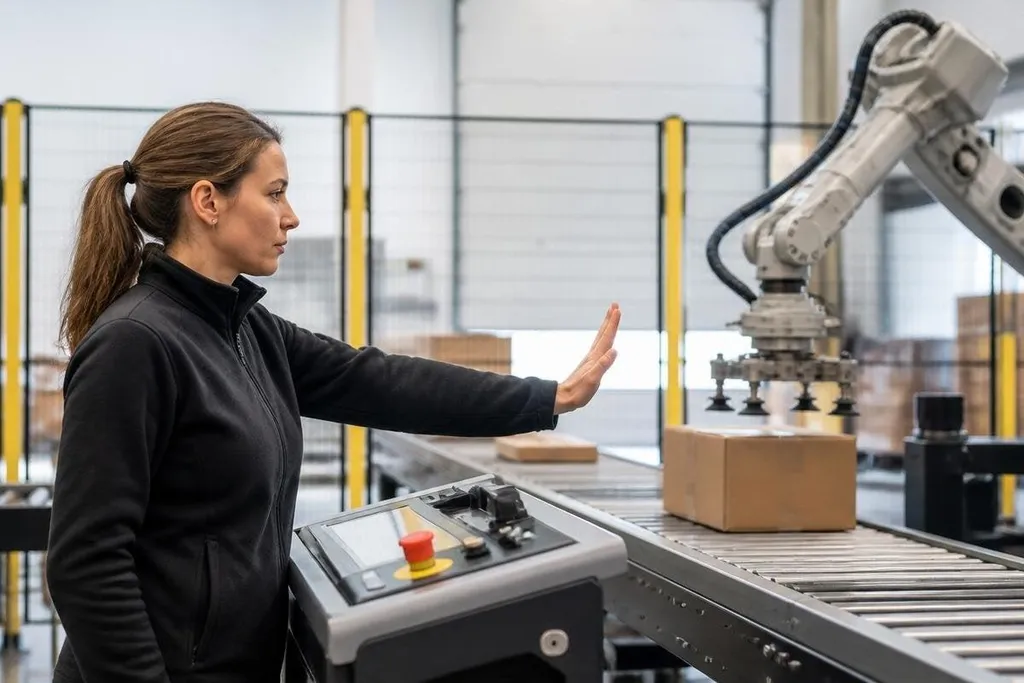
An automated system can sort a parcel, approve a loan, guide a vehicle, or control a factory arm in seconds. The person affected by that decision still needs a clear way to understand it, challenge it, and stop it when something goes wrong.
Quick read
- Human control needs a real action, such as pause, reject, correct, or appeal.
- A supervisor cannot control a system without useful information about its status and limits.
- Automation should slow down when the cost of a wrong decision is high.
Control means more than permission
A button marked “override” does not give a person meaningful control if the system ignores it, hides it, or makes the result impossible to reverse. Control starts before an automated action and continues after it.
That means a person should know what the system is about to do, why it reached that point, and what will happen after approval. The details will differ between a warehouse robot and an automated hiring tool, but the basic need stays the same: people need a clear point where they can act.
A useful control system gives a person enough time and information to make that choice. A flashing warning with no explanation does little for a supervisor who must decide whether a robot should keep moving near workers.
Automation needs a human stop path
A stop path is the set of actions that lets a person pause, correct, or shut down an automated process. It should be easy to find during normal work and during an emergency.
For a mobile robot, that path may include a physical emergency stop, a remote pause command, and a safe restart procedure.
Each one serves a different moment. The emergency stop deals with immediate danger; the pause command can help with a blocked route; the restart procedure prevents the robot from repeating the same movement without a fresh check.
The system should also record what happened. A time stamp, system state, operator action, and restart result can help a team find the cause of a failure. That record matters when the same fault appears on another robot or affects a customer.
The person in charge needs authority that matches the risk. If a worker can pause a machine but cannot keep it paused, their control ends too soon. If a manager can approve a decision but cannot see the data behind it, approval becomes a formality.
Human control depends on good information
People cannot supervise a system from a single green status light. They need plain warnings, current system state, known limits, and a record of recent actions.
A human override matters only if the record shows when it was available and what the robot did next. A report from Robot 24 can place the robot’s model, test site, and handoff beside the company’s claim. That evidence leads to a practical test: can the dashboard show the robot’s state before a person needs to stop it?
A dashboard should answer practical questions quickly. Is the robot following its planned route? Has a sensor failed? Is a person inside the work area? Which action will the system take next? If the answer takes several screens, the control design has already created a problem.
The system should show uncertainty in a way a worker can act on. “Object detected” gives less help than “object detected at 2 m; path blocked; pause recommended.” Clear language supports a better decision without asking the operator to decode internal software terms.
Decide where people must stay in charge
Human control makes the most sense where a mistake can injure someone, remove access to money or work, expose private data, or create a result that is hard to reverse. Low-risk tasks can run with less supervision when the system has a safe stop and a clear record.
I'd keep a person in the approval loop for decisions that change someone’s rights or safety, even when the automated system has a strong record. Past performance can support a decision; it cannot replace a way to challenge the result.
The strongest opposing view is that extra approval slows work. That cost is real, but speed has less value when a mistake takes days to fix or leaves no clear owner.
A practical control check
Use these questions before putting an automated system into daily work:
- Find the stop: Can a trained worker pause the system in one clear action?
- Check the reason: Does the interface explain the next action in plain language?
- Test the restart: After a stop, does the system wait for a fresh human check?
- Name the owner: Is one person responsible for reviewing failures and appeals?
- Keep the record: Can the team see what the system did, when it acted, and who changed its state?
- Set the boundary: Which decisions must receive human approval every time?
These checks turn human control from a policy sentence into a feature people can use. They also show where automation should stop before deployment, rather than after a failure has already reached the public.
The right to human control will be tested at the point where a person needs to say “stop” and the system must respond. If that action is unclear, slow, or impossible to verify, the system has transferred responsibility without transferring power.